Positivo BGH participates in “Kenya Digital Literacy Program”
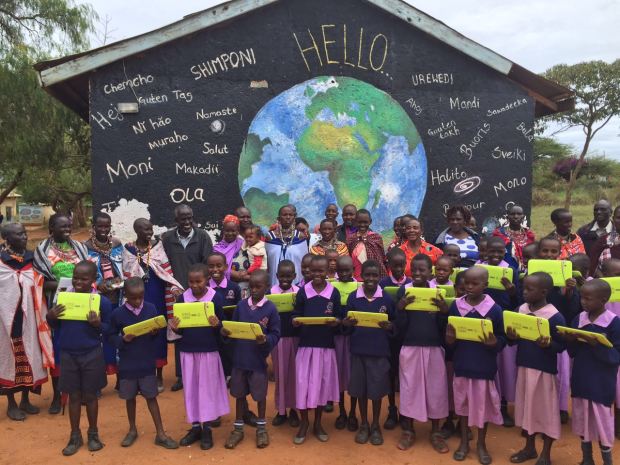
The aim of this program is to develop necessary skills to build a knowledge economy while improving education for every child in Kenya
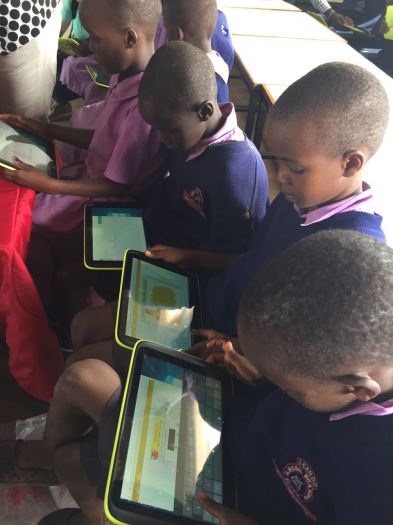
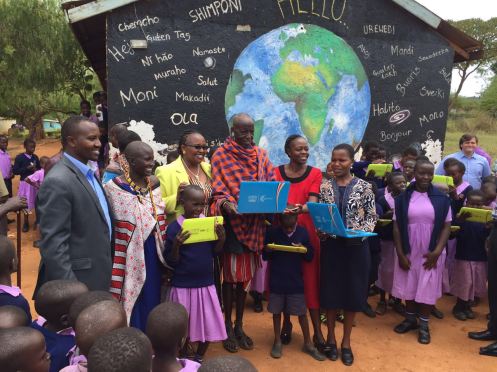
Positivo BGH, in association with JKUAT University, takes part in the “Kenya’s Digital Literacy Programme”[1], consequently we are very proud for our work to provide tablets, notebooks, servers, internet connection and training for children and professors to develop and achieve the objectives of Kenya’s educational project. This project emphasizes Kenya’s long-term vision of creating a knowledge-based economy.
As you can see in the photo with these smiling children, our work transcends the purpose as enterprise and it is bringing us a sensation to improve a virtuous and fair world.
Working as a Board Member of Positivo BGH as well as researching in the field of economic development, the perception to fill the gap between the thoughts written and shared in articles, and being a part of it putting into practice all these ideas in this project, it is a unique personal fulfillment.
Nowadays, in this era of “Digital Globalization”, the nations compete for ideas, skills and knowledge instead of reducing the costs of their products. Consequently this kind of competition disrupts the traditional models to develop and participate in the global world economy in every country, giving to developing countries a new opportunity to redefine and build their comparative advantages to be competitive and vigorous. Making the most of this moment, while the rules of the competition are changing, it is essential to transform the economic instruments and approaches to achieve other economic position.
The vital role of the governments providing strategy, support and resources to produce intense structural changes are non-delegable responsibility on account that the private area will not be produced to all sectors of society by themselves. Investment in public education, R&D and the infrastructure to promote and support a “Knowledge-based Economy” is a duty that the government can not evade.
Accomplishing a better quality of education for whole society is understood as crucial power shift basis that the success of nations depends on human and intellectual capital. In the current times, the Low-skilled and Cheap jobs have been changing to High-skilled with High-waved, as the key factor to be competitive in this unavoidable reality of the global economy without borders in knowledges and learnings.
Applying technologies in schools, opens the mind of professors and students in many aspects like: breaking the boundaries of space and time, access to a world of information at their fingertips, adopt a more inclusive and tolerant outlook, encourages working in teams among them or with others colleagues around the world, open to knowledge and opportunities in the entire world, combined resources of its academic institutions with the research enterprises within the public and private sectors, give an essential tool to look for educational training around the world, along with others.
Over the world is recognized that implements technology isolated is not the central solution to improve the quality of education for children. However, when researching the status of developing countries, mostly in “Least Developed Countries”, it is an important and prompt tool can be implemented that generates an impressive qualitative leap forward that catalyzes other actions to achieve this necessary quality of education to be part in the current world.
As you can see in this World Economic Forum article by Elsie Kanza: “Only 20% of Africans use the internet – we must fix this digital poverty now”[2] the inequality access to digital world is impressive when you compare the Least Developed Countries (LDCs) with the developed countries is only the 9,5% compared with the 82,2% of developed countries.
Percentage of Individual using the Internet
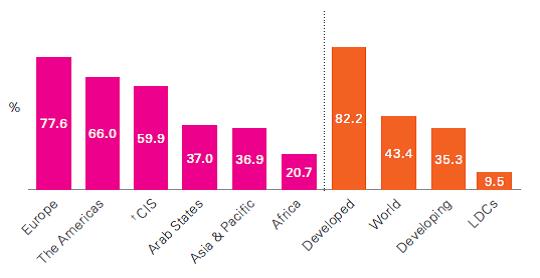
Source: International Telecommunications Union
In 2015 had an 3,2 billions of internet users around the world, but in Africa only 20,7% of the individuals have access to internet, but when you compare the households with internet access is reduced to 10,7% compare with the 82,1% in Europe[3].
Having said this, the necessity of understanding and developing their digital program education, especially those it is describe as “Least Developed Countries”, it is not only a key factor of economic development, but also enriching people´s understanding of themselves, increasing their qualities of lives and changing a complete social attitude. This is an objective which all of us have to work for it.
[1] http://digischool.icta.go.ke/
[2] https://www.weforum.org/agenda/2016/04/only-20-of-africans-use-the-internet-we-must-fix-this-digital-poverty-now
[3] Statistics obtained by Committed to connecting the world. http://www.itu.int/en/Pages/default.aspx
