The long radical wave is coming!

The perfect social storm by an unknown radical innovation
The symptoms not the causes of the turmoil
The economic crisis that started with the financial Sub-prime crisis in 2007 is being handled but it is not over, we are facing a litany recovery. The consequences of the crisis are exploiting on social and political instabilities predominantly in develop countries (DCs) with the Brexit, as a major manifestation.
The well-known speeches looking for foreigner causes are now established in develop countries as: xenophobia, anti-globalization, racism, anti-establishment, political and economic isolation, blame to others for their incompetence, and more. Nowadays these societies appropriate these wrong and crazy slogans from less develop countries (LDCs), which normally use these mottos to excuse themselves. Nevertheless, the develop countries do not suffer from the radical and unparalleled social difficulties that they have as poverty, hunger, starvation, lack of medical care, among others.
In these develop countries, when the economy goes well it seems that these social symptoms are relent, disappear and the leaders don´t take into consideration to fight it. Nevertheless, when the economic crisis emerges and the recovery doesn´t come out in a long time, these kinds of crazy reaction flourishes within societies. Essentially, these kinds of thoughts must be fought by social leaders with strong, constant an extensive cultural education for the entire society, rather than the essential academic education that is overrated as a universal solution.
As a result of this economic litany and social discomfort which is gestating, charismatic and popular leaders are emerging. They capitalize these social symptoms and propose solutions that will bring deeper social drawbacks than the proceeded economic one. The followers of these leaders vote thinking that the candidate will save them and change the present and “terrible” situation that they perceive as real, voting without the rational thought of future consequences. The anger is mixed with disappointment and desires for an unknown way to reach an ideal future.
The battle for the inevitable change caused by new innovative cycle
Trying to understand the social dilemmas without the approach of three edges of the social sciences triangle (economical, psychological and sociological), is not recognizing as a whole and inseparable study of the set of causes and effects on the social complexities.
Nowadays we live in an instant interconnected world via internet, with different ways of social communications, low-cost transports and access to entire cheap products of the world. This is all we have got with the radical innovations and its social consequences since the industrial revolution in 1771 until now.
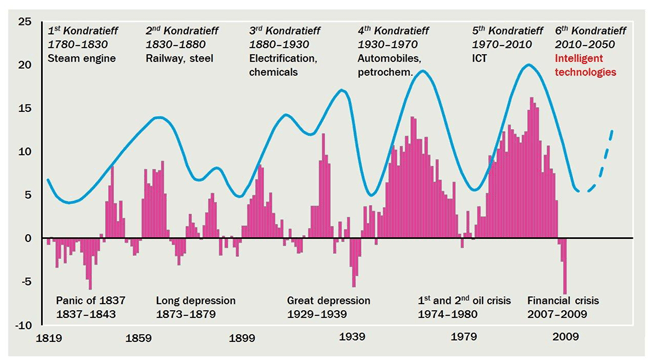
When we observe history in the perspective of social-economic cycles induced by radical innovations, these kinds of causes, effects and disorders are perceived in the end of every cycle . Each new radical technology innovation not only transforms the business field but also the socio-institutional context and even the culture of the world. Finally triggers the well-known phenomenon of human and social resistance to change.
Source: Wilenius and Kurki (2012)
The main economic sources are replaced by new emerging ones. The working skills become obsolete and unproductive, requiring new ways of thinking and specific knowledge that has to be learned. This change causes a high rate of unemployment in certain areas and labor shortages in others. It also appears new growing business with impressive speeds that in certain fields it is impossible to do the adaptation of the current businessmen destroying many enterprises, collapsing the old economic status-quo, unbalancing the benefits within the society and increasing the inequality incomes.
A social symptom of this that we can observe now, it is proved in the Brexit demographics poll, that illustrates that 73% of voters between the aged of 18-24 voted for Remain and 57% of degree-holders to stay, while most of those with only secondary-school educations wanted to leave in the European Union. This demonstrates the fear for changes a part of the British society, having won another ancient worldview. (Economist, 2016)
The beginning of a new cycle with an unknown radical innovation
The finish of the fifth and the emerge of the sixth cycle is being perceived by these kinds of turmoil not knowing what is this new innovation. The difficult resides basically in a radical innovation that is recognized “ex-post”, only when it is spread and accepted in the market. It might be possibly confused with an incremental innovation, which changes the way of production and product use, but it does not totally change the social and institutional environment.
Definitely the world is entering in the sixth wave of unknown techno-economic paradigm. Consequently, many countries have been anticipating to this new cycle and have been researching, promoting and supporting public and private enterprises in potential areas of radical innovation as: Robotics, Big Data, Nanotechnology, Bioeconomy, Alternative energies, Personalized medicine, Moderns Health Care for ageing, Genetic, Molecular Biology, and more.
We have to prepare for this sixth wave, generating the base of education, entrepreneur spirit and governmental support for new enterprises in these new fields.
Having in mind that this sixth cycle is starting with social crisis as unemployment, reeducation of workers skills, relocation of people into different fields of work, companies and people bankruptcies, and more, governments have the fundamental role to plan, support and cope with these problems, protecting and helping the transition from one cycle to the other.
A brief of the long waves history
The social-economical long waves produced by technological changes and its consequences was researched and revealed by the economist Nikolai Kondratieff and after time was studied in depth by Schumpeter, Freeman, Nelson, Pérez and others.
Since the Industrial Revolution until the current times, five long waves are being studied and demonstrated that certain radical innovations forced these cycles, as it can be seen in the previous figure.
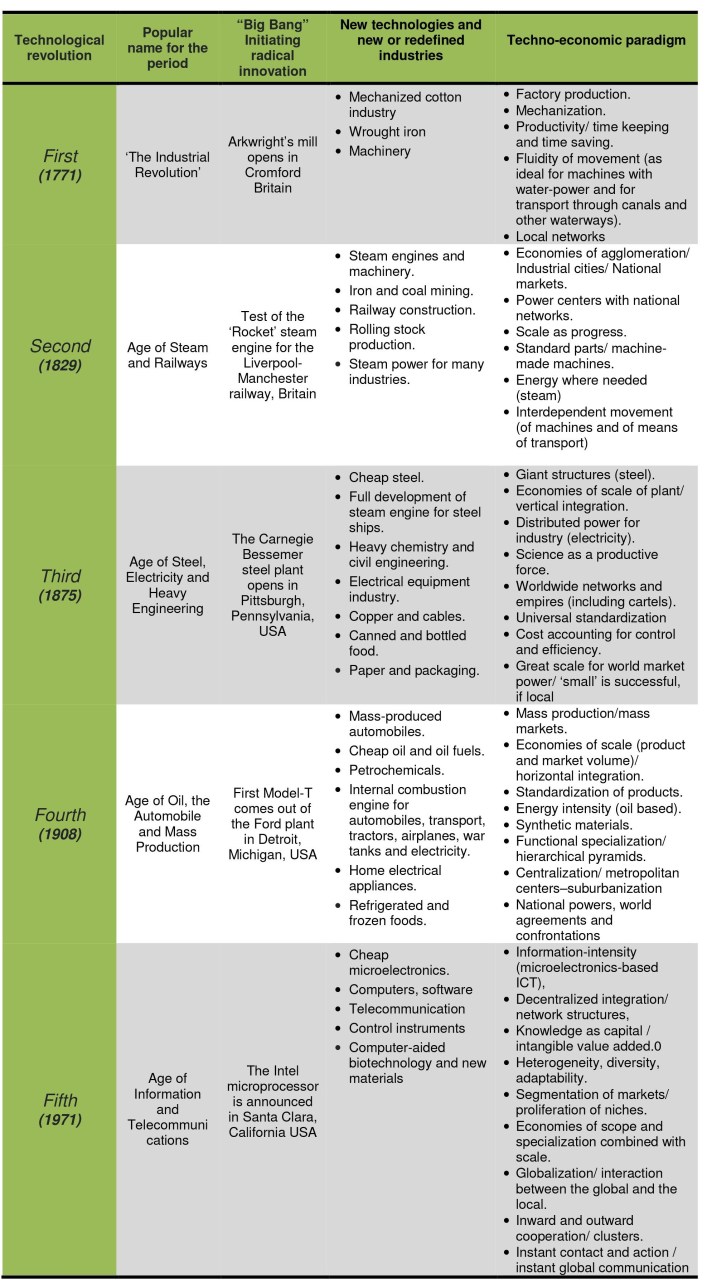
This radical innovation that Schumpeter called “creative destruction” and Freeman and Perez called “Big Bang initiating” and produced a “Techno-economic paradigm”, could be seen as a resume of the consequences of this revolution in this chart:
Source: Perez (2010)
References:
Economist, T. (2016). Britain votes to leave the EU. The Economist. Retrieved from
Freeman, C., & Perez, C. (1988). Structural Crises of Adjustment, Business Cycles and Investment Behaviour. In G. e. a. Dosi (Ed.), Technical change and economic theory (pp. 38-66): Edited and compiled by the Maastricht Economic Research Institute on Innovation and Technology International Federation of Institutes for Advanced Study London and New York: Pinter; Distributed by Columbia University Press, New York.
Kondratieff, N. (1935). The long waves in economic life [translated by W. F. Stolper]. Review of Economics and Statistics, 17, 105-115.
Nelson, R. (2008). Economic Development from the Perspective of Evolutionary Economic Theory. Oxford Development Studies, 36(1), 9-21. doi: http://www.tandf.co.uk/journals/titles/13600818.asp
Perez, C. (2010). Technological Revolutions and Techno-economic Paradigms. Cambridge Journal of Economics, 34(1), 185-202.
Schumpeter, J. (1939). Business Cycles: A Theoretical, Historical and Statistical Analysis of the Capitalist Process (Vol. 1). New York: McGraw Hill.
Wilenius, M., & Kurki, S. (2012). Surfing the sixth wave. Exploring the next 40 years of global change. Finland Futures Research Centre. FFRC eBOOK, 10, 2012.

Dr Bablo. Thank you for this blog posting, this is absolutely useful for my own research in innovation management. Thank you very much for this great article, we are in agreement..
Me gustaLe gusta a 1 persona
Thank you for your words, I am at your disposal for any help you need.
Me gustaMe gusta
Estoy de acuerdo en la descripción, no le daría al BREXIT tanta importancia en los países en desarrollo. Tenes que ver como se integra el papel financiero con el tecnológico-industrial ya que actualmente el motor es al revés y de largo plazo lo que diferencia el núcleo-core del ciclo de Kondratieff. Abrazo. Mario Burkún
Me gustaMe gusta